Downloads

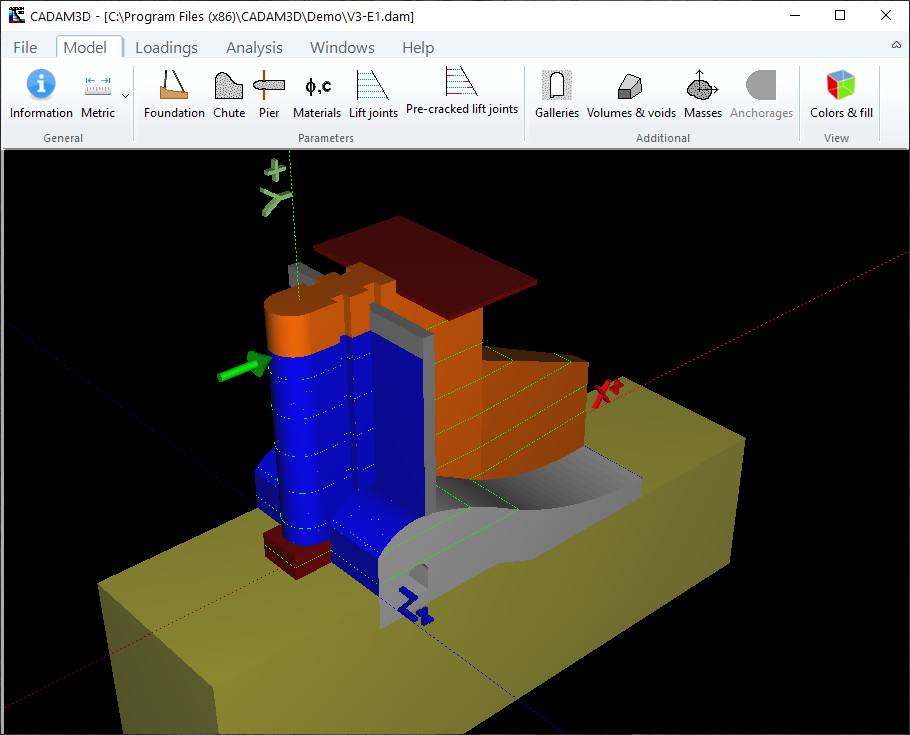
CADAM3D is a user-friendly software based on the gravity method originally developed for one of the world biggest concrete dam owner, Hydro-Quebec, and for Dams and Hydrology of the Quebec Ministry of Environment (Quebec's legislator for dam safety). CADAM3D is fully functional and is intensively used by Hydro-Quebec since 2005. To our knowledge, no other software similar to CADAM3D is available at this time.
If you perform stability analyzes of concrete hydraulic structures, this software will allow you to perform them much faster and more efficiently. If you are interested in this type of software and would like to try CADAM3D for free, please click on the button "Contact us for a free trial of CADAM3D" to send us a message.
Operators need to see how a temperature or pressure changed over time. MCGS Pro provides:
Headline: Optimize Your Industrial Interface with MCGS Pro 💻⚙️
Post: Looking for a reliable, cost-effective way to build Human-Machine Interfaces (HMI) for your automation projects? Meet MCGS Pro.
While many engineers are familiar with the older MCGS Embedded, MCGS Pro is the unified configuration software designed for both embedded and industrial PC-based HMIs. mcgs pro hmi software
Why use MCGS Pro? ✅ Versatile Compatibility: Supports Ethernet, serial (RS232/485), and USB connections. ✅ Rich Libraries: Pre-built objects for gauges, trends, data logs, and alarms. ✅ Scripting Power: Uses simplified "Run Script" language for complex logic without full-blown coding. ✅ Database Integration: Easily connects to SQL databases and Excel for data reporting. ✅ Cost-Effective: A great mid-range alternative to premium brands like Pro-face or WinCC.
Pro Tip: When migrating from older MCGS files, always use the "Project Upgrade" tool to avoid object library conflicts.
👉 Who else is using MCGS Pro on their PLCs (Siemens, Omron, Mitsubishi)? Drop your experience below. Operators need to see how a temperature or
#HMISoftware #MCGSPro #IndustrialAutomation #PLCProgramming #SCADA
The Real-time Database (RTDB) is the core of the system. Variables are defined corresponding to the PLC memory addresses.
For batch processes, the recipe feature allows operators to download predefined parameter sets (e.g., temperature, pressure, time) to the PLC with a single button. Recipes can be created, edited, and stored directly on the HMI or on external media. The Real-time Database (RTDB) is the core of the system
The MCGS Pro real-time database acts as the software’s memory hub. Tags (variables) are created centrally and can be defined with data types, scaling, deadbands, and initial values. This centralized approach means changing a tag's address updates it globally across all screens—saving tremendous debugging time.
While most actions are configurable without code, complex logic requires scripting. MCGS Pro uses a C-like scripting language (called "Run Script"). You can write conditional logic (IF...THEN), loops, and mathematical calculations. For example:
!SetData(Current_Value, "Local", "PLC_Tag", 1, 1)
| Key | Action |
|-----|--------|
| F2 | Rename selected object |
| Ctrl+G | Group objects |
| Ctrl+U | Ungroup |
| F5 | Start simulation |
| F8 | Compile project |
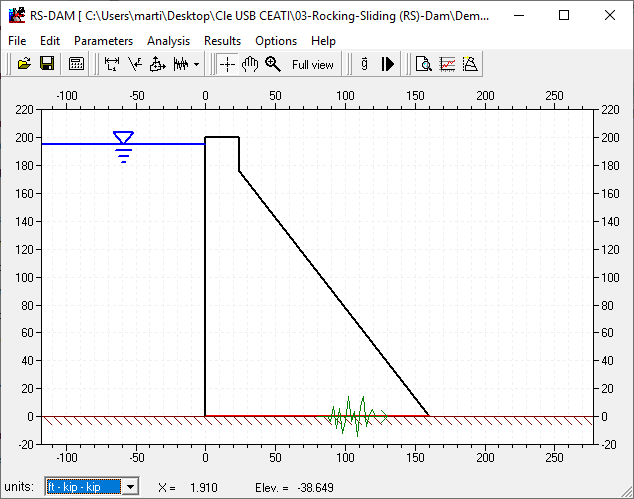
RS-DAM is a computer program that was primarily designed to provide a computational tool to evaluate the transient response of a completely cracked concrete dam section subjected to seismic loads. RS-DAM is also used to support research and development on structural behavior and safety of concrete dams.
RS-DAM is based on rigid body dynamic equilibrium. It performs a transient rocking and/or sliding analysis of a cracked dam section subjected to either base accelerations or time varying forces. Several modelling options have been included to allow users to explore the influence of parameters (e.g. geometry, additional masses, variation of the uplift force upon rotation, hydrodynamic pressures in translation (Westergaard) and rotation, center of rotation moving with sliding, coefficient of restitution of impact, etc...). RS-DAM is developed in a university context and has no commercial aspect.
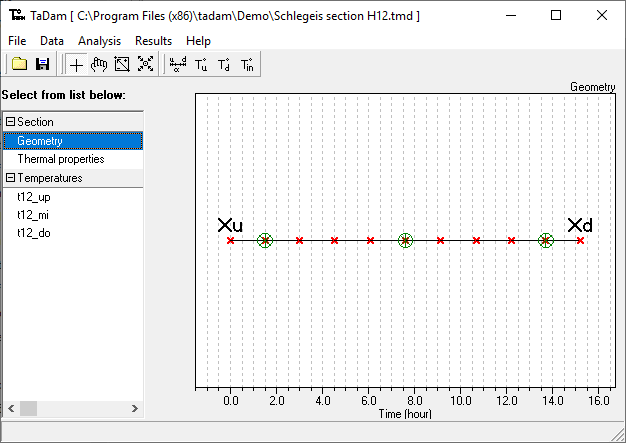
TADAM (Thermal Analysis of concrete DAMs) software employs a new frequency-domain solution technique to solve the 1D thermal transfer problem, allowing the calculation of temperature histories in a concrete dam section.
The direct solution calculates the evolution of the temperature distributions from the temperature histories of the upstream and downstream faces. The inverse solution uses temperature histories, measured inside the section, in order to calculate the temperature fields at the external faces, while taking into account the thermal wave attenuation effects and the phase angles along the section.
TADAM is developed in a university context and has no commercial aspect.